
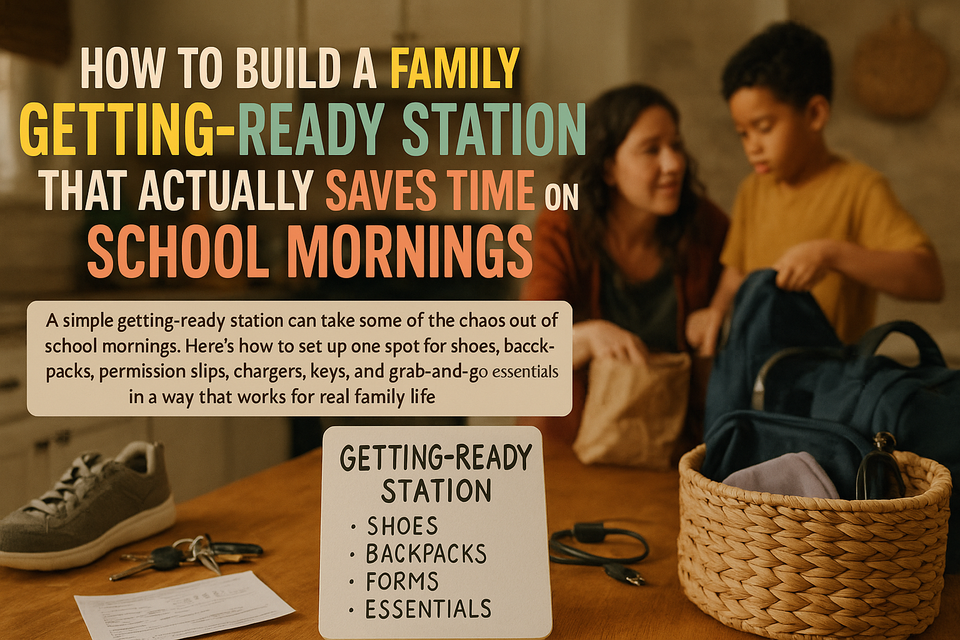
How to Build a Family Getting-Ready Station That Actually Saves Time on School Mornings.
School mornings rarely fall apart because of one big problem. It’s usually five small ones happening at once.
A missing shoe. A dead phone. A permission slip buried under junk mail. Someone yelling, “Where’s my backpack?” while you’re trying to find your keys and remember whether anyone ate breakfast.
If that sounds familiar, you do not need a better personality or a stricter routine. You probably just need fewer decision points before everyone walks out the door.
That’s where a family getting-ready station helps.
This is not about creating a picture-perfect mudroom with matching bins and beautiful labels. It’s about giving the everyday essentials one reliable home so mornings involve less searching, less reminding, and less last-minute scrambling.
What a getting-ready station actually is
A family getting-ready station is one small area near the door where the things you need most often live on purpose.
Think of it as your launch zone for school and work.
A useful station usually holds:
- Shoes that are worn regularly
- Backpacks
- Lunch boxes or water bottles
- Keys
- Chargers
- Permission slips or forms
- Library books, sports items, or other returnables
- Grab-and-go items like granola bars, hair ties, tissues, or lip balm
The goal is simple: if an item creates morning stress more than once a week, it probably belongs here.
Pick the right spot, not the perfect spot
Most families do best when the station is as close to the exit as possible.
That might be:
- A mudroom
- A hallway by the front door
- One side of the kitchen
- A corner of the garage entry
- A section of a dining room wall
- Even a narrow stretch of apartment entryway
Real Talk: the best location is not the prettiest one. It’s the one people actually pass through every day.
If your kids come in through the garage, don’t put the station by the formal front door that nobody uses. If backpacks always land in the kitchen, build the system around that reality instead of fighting it.
Keep only the essentials there
One reason these stations stop working is that they become storage for everything.
When the area fills up with old art projects, random mail, outgrown shoes, and sports gear from three seasons ago, the important things disappear again.
Start by choosing what deserves space in the station right now.
Good candidates for the station
- Current school shoes
- One backpack per child
- Daily chargers
- House keys and car keys
- Papers that need signatures or need to go back to school
- A small basket for items to return
- Weather-dependent items in season, like umbrellas or gloves
Better stored somewhere else
- Extra shoes
- Old school papers
- Bulk snacks
- Keepsakes
- Off-season gear
- Every charging cable you own
If your station has too many jobs, it stops doing the main one.
Build it in simple zones
You do not need fancy furniture. You need clear categories.
A basic getting-ready station works well with five zones.
1. The shoe zone
This is where a lot of morning time disappears.
Keep it easy:
- Limit each person to one or two pairs of everyday shoes in the station
- Use a small shoe rack, tray, or designated floor spot
- Put the most-used shoes on the easiest-to-reach level
- If kids kick shoes off randomly, outline the spot with a basket or mat so it’s visually obvious where they go
If you have younger kids and teens, give everyone a clearly defined spot instead of one shared pile.
2. The backpack zone
Every child needs one obvious home for their backpack.
This can be:
- A wall hook
- A locker-style cubby
- The back of a bench
- A sturdy basket if hooks don’t work for your space
Hooks are often easiest because they keep bags visible and off the floor. For teens especially, visibility matters. If they can’t see it, they may swear it doesn’t exist.
If possible, add one extra hook for things that need to leave the house the next day, like a sports bag, instrument, or sweatshirt.
3. The paper zone
Permission slips, school flyers, forms, and reminder notes create a lot of hidden stress because they’re easy to lose and easy to forget.
Use one small vertical file, wall pocket, or tray with simple labels like:
- To sign
- To return
- To file or review
Do not create a complicated filing system here. This is a short-term holding area, not your household archive.
A good rule: papers should either be handled tonight or clearly placed where they can’t disappear.
4. The charging and keys zone
Phones, tablets, headphones, watches, and keys have a way of wandering right when you’re trying to leave.
A small charging station can solve a surprising amount of chaos.
Try:
- A basket or tray for devices
- A multi-port charger
- One hook or bowl for keys
- Labels only if your family genuinely uses them
If screen habits are a challenge, the station can double as the overnight charging area. That’s not required, but for many families it helps both with device management and with finding charged items in the morning.
5. The grab-and-go zone
This is the part that saves the day when mornings are running behind.
Stock a small bin or basket with things people ask for at the last second:
- Granola bars
- Fruit pouches
- Mints or gum for older kids
- Hair ties
- Tissues
- Lip balm
- Sunscreen stick
- Deodorant
- Travel-size hand sanitizer
You’re not trying to replace breakfast or pack a full emergency kit. You’re just reducing the number of tiny interruptions between “put on your shoes” and “get in the car.”
Choose storage that matches your family
The best setup depends less on style and more on habits.
If your family drops everything fast, use open storage. Closed bins with lids often become invisible.
A simple setup might include:
- Wall hooks
- A narrow bench with cubbies
- A shoe tray
- Small labeled baskets
- A wall file for papers
- A charging dock or power strip
- A small basket for keys and wallet
If space is tight, go vertical.
Use:
- Over-the-door hooks
- Wall-mounted mail organizers
- Stackable bins
- Slim shoe racks
- A peg rail
If your kids ignore labels, use names plus pictures or just assign spots by location: left hook, middle cubby, top basket.
Make it easy to reset every evening
A getting-ready station only saves time if it gets reset often enough. The good news is that “often enough” does not mean perfectly.
Aim for a 5-minute evening reset.
That might look like:
- Backpacks hung up
- Papers moved to the right tray
- Devices plugged in
- Shoes paired up
- Keys returned
- Anything needed tomorrow placed by the bag
This works especially well right after dinner or before everyone heads upstairs.
Real Talk: don’t make this a giant nightly production. If the system takes 25 minutes to maintain, nobody will keep doing it.
Plan for the problem items
Every family has a few things that repeatedly create chaos.
Maybe it’s:
- Soccer cleats
- Library books
- Band instruments
- Gym clothes
- Signed forms
- Prescription glasses
- Bus cards
Instead of hoping people remember, build those items into the station.
Examples:
- Put a “return to school” basket by the backpacks
- Keep library books on the bottom shelf only
- Add a clip for forms that must go out the next day
- Store bus passes in the same pouch every time
- Place sports gear in one labeled bin near the exit the night before
The system should reflect your actual friction points, not someone else’s.
A sample setup for a busy family
If you’re not sure where to start, here’s a realistic example.
Near the garage door:
- A bench with two cubbies for daily shoes
- Three wall hooks for backpacks and one extra hook for sports gear
- A small wall file with “To Sign” and “Going Back” slots
- A basket on the bench for keys, wallet, and sunglasses
- A charging strip on a nearby shelf
- One snack bin with bars and drink packets
- One small basket labeled “Don’t Forget” for items that need to leave tomorrow
That’s it. Not fancy. Not complicated. But it covers the most common morning bottlenecks.
How to get your family to actually use it
This part matters. Even the smartest setup fails if it depends on constant reminders.
A few ways to make use more likely:
- Put the station directly in the path of traffic
- Make each spot obvious and easy to reach
- Reduce the number of steps
- Involve kids in setting up their own space
- Start with the most frustrating items first
- Adjust after a week if something keeps piling up elsewhere
And most importantly, don’t wait until the whole house is organized to create this one zone.
A functional corner by the door can help even if the rest of the house still looks like real family life.
What not to do
A few common mistakes make these stations harder to use than they need to be.
Avoid:
- Making it too big
- Storing every school supply there
- Using containers your kids can’t easily open or reach
- Creating a system with too many labels or categories
- Treating one missed day like the system failed
- Expecting the station to fix oversleeping, unfinished homework, or every morning conflict
This setup is meant to remove friction, not create a perfect morning.
And honestly, less friction is enough.
Start small this week
If you’re overwhelmed, do not try to build the ultimate family command center this weekend.
Start with these three things:
- Add a place for backpacks
- Add a place for shoes
- Add one tray or basket for papers and keys
Use it for a week.
Then notice what still causes last-minute stress. That’s what you add next.
A good system grows from real life. It does not arrive fully finished.
Conclusion
A family getting-ready station won’t make school mornings magically calm, and it won’t turn a busy household into a perfectly efficient machine. But it can remove a lot of the unnecessary chaos.
When shoes, backpacks, keys, chargers, and school papers all have one reliable home, you spend less time searching and more time simply moving through the morning.
That’s really the goal: not perfect routines, but fewer preventable problems.
If your mornings feel frantic, start by giving the most important things a place to land. Sometimes that small shift is enough to make the whole beginning of the day feel a little more manageable.