
The “No Nag” System
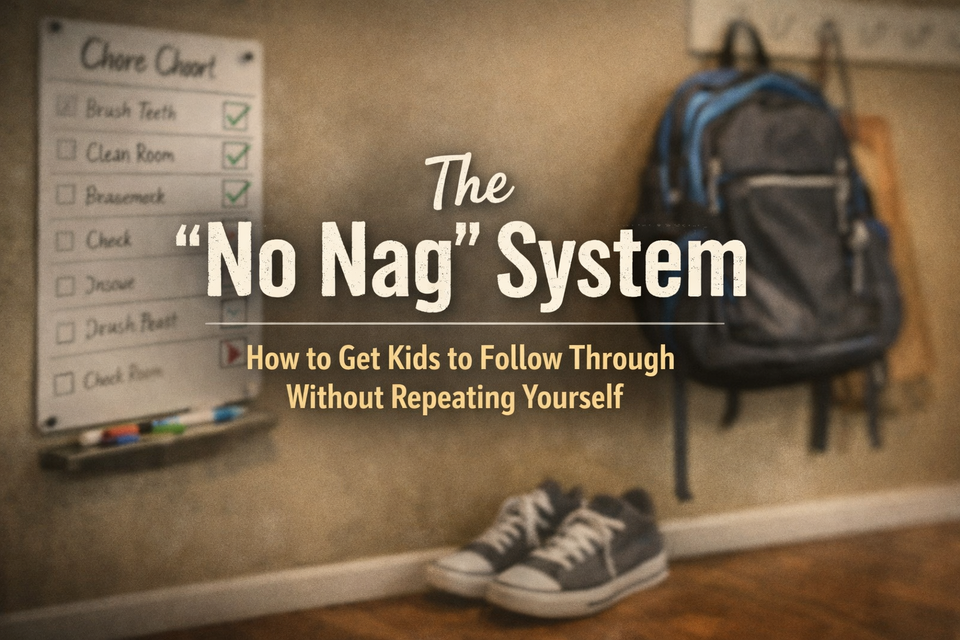
How to Get Kids to Follow Through Without Repeating Yourself
If you’ve ever said the same thing three times (or ten) and still didn’t get results, you’re not alone.
“Pick up your shoes.”
“Did you brush your teeth?”
“Hey… I asked you already.”
At some point, it starts to feel like your voice is just background noise.
The problem isn’t your kids.
And it’s not that they don’t hear you.
It’s that you’ve accidentally trained a system where reminders are expected.
Let’s fix that.
Why Nagging Doesn’t Work (Even When It Feels Necessary)
Nagging usually comes from a good place—you want things done, and you want to avoid consequences later.
But over time, it creates a pattern:
- Kids wait for reminders instead of taking action
- Parents repeat instructions until something happens
- Everyone gets frustrated
The more you repeat, the less your words carry weight.
Not because your kids don’t care…
But because they’ve learned they don’t have to act the first time.
The Shift: From Reminders to Systems
The “No Nag” system isn’t about being stricter.
It’s about removing the need for constant reminders entirely.
Instead of:
“Do this now”
You move toward:
“This is how it works every time”
That shift changes everything.
Step 1: Make Expectations Visible (Not Verbal)
Verbal reminders disappear instantly.
Visual systems stick.
Instead of repeating tasks, create something your kids can see:
- A simple checklist on the wall
- A whiteboard with daily responsibilities
- A morning or evening routine card
Examples:
- Morning: Brush teeth → Get dressed → Grab backpack
- Evening: Homework → Clean up → Prep for tomorrow
When it’s visible, you don’t have to say it.
Step 2: Say It Once, Then Step Back
This is the hardest part.
You give the instruction once:
“Check your list before you sit down.”
And then… you stop.
No repeating. No chasing.
If it doesn’t happen, you don’t fill the gap with more reminders.
You let the system do its job.
Step 3: Let Natural Consequences Do the Talking
This is where the real learning happens.
If they forget something:
- They feel it
- They deal with it
- They remember next time
Examples:
- Forgot homework → deal with teacher
- Didn’t bring lunch → feel hungry (within reason)
- Didn’t clean up → lose access to the space/activity
The key is consistency—not punishment.
Step 4: Replace Control with Ownership
Instead of:
“Go do this right now”
Try:
“What’s next on your list?”
You’re shifting responsibility back to them.
It’s subtle, but powerful.
They’re no longer reacting to you…
They’re following a system they understand.
Step 5: Stay Calm When It Doesn’t Work (At First)
This won’t click overnight.
At first, it might feel like things are getting worse:
- Tasks get missed
- You’ll want to jump in
- Old habits will try to take over
That’s normal.
You’re breaking a pattern that’s been reinforced for years.
Stick with it.
What Changes Over Time
When this system starts working, you’ll notice:
- Less repeating
- Less tension
- More independence
- Kids taking initiative without being asked
And maybe the biggest shift:
You stop feeling like the “constant reminder machine.”
Final Thought
Nagging isn’t a parenting failure—it’s usually a sign that the system isn’t working yet.
When you replace reminders with structure, everything gets lighter.
Not perfect.
Not instant.
But better.
And sometimes, better is exactly what your home needs.